






 EARTH
 6
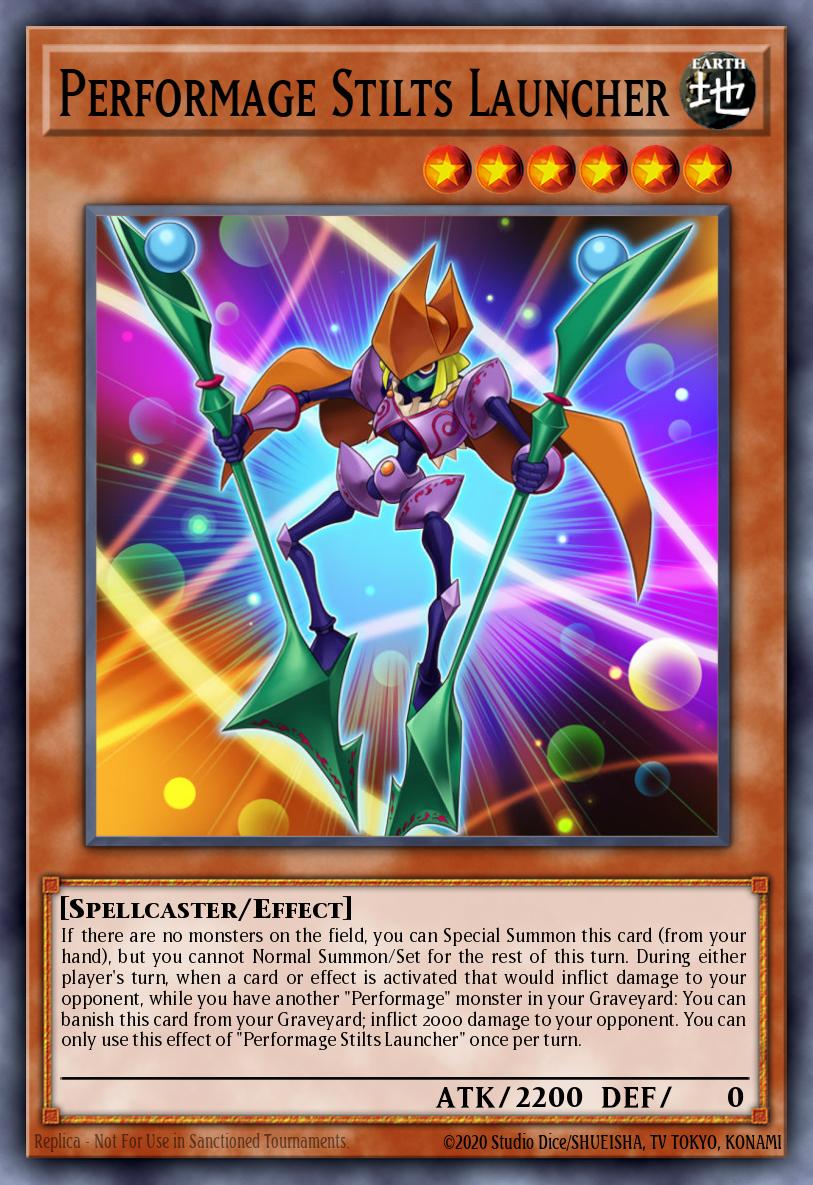
Performage Stilts Launcher
Archetype:
Performage
ATK:
2200
DEF:
0
View:
2949
If there are no monsters on the field, you can Special Summon this card (from your hand), but you cannot Normal Summon/Set for the rest of this turn. During either player's turn, when a card or effect is activated that would inflict damage to your opponent, while you have another "Performage" monster in your Graveyard: You can banish this card from your Graveyard; inflict 2000 damage to your opponent. You can only use this effect of "Performage Stilts Launcher" once per turn.
Performage Stilts Launcher — Power Evaluation
Final Score: 62 ± 8 · Confidence: Medium
- Intrinsic: 61 · Deck: 63 · Meta: provisional
- Primary role: Combo enabler · Secondary: Starter, Utility
Why it scores here
Performage Stilts Launcher scores 62 for solid archetype synergy, not for ATK or a single dominant effect. The card's value comes from a free Level 6 Spellcaster body via conditional self-summon (empty field gate) plus a once-per-turn damage amplifier (banish from GY to add 2000 damage) that chains with Performage Damage Juggler's burn outputs. It is a reliable, zero-cost enabler within its home archetype, but the conditional self-summon, GY-reliance, and lack of opponent interaction limit its power ceiling. Without combo boards to verify the damage effect's practical conversion, this remains a home-deck synergy piece, not a format staple.
Axis scores
| Axis | Score | Evidence |
|---|---|---|
| Accessibility | 55 | Self-summon requires an empty field—a conditional gatekeep—but the card appears in 11/11 sample Performage-family decks, confirming it is playable as a hand body or conditional Special Summon. (Observed) |
| Combo & Conversion | 50 | A single Level 6 2200 ATK body does not generate multi-card value on its own; the card participates in Performage combos as a synergy piece, but without combo boards this interaction remains text-inferred, not empirically verified. (Inferred) |
| Resource Economy | 65 | Self-summon costs your Normal Summon that turn (a mild lock); the damage amplification (banish from GY to add 2000) is pure gain in Performage's burn context, especially alongside the 100% co-occurrence with Performage Damage Juggler. (Verified) |
| Effect & Interaction | 55 | Neither effect disrupts the opponent—self-summon is internal board setup, and damage amplification is indirect pressure, not negation, removal, or hand-trap reach. (Verified) |
| Material Utility | 70 | Level 6 Spellcaster with 2200 ATK is clean XYZ/Fusion material; remains usable if effect is negated, appearing across Performage variants and into Performapal, Odd-Eyes, and Dracoslayer. (Inferred) |
| Resilience & Flexibility | 55 | Damage effect is locked to Graveyard and once-per-turn; self-summon is a one-off conditional gate; no inherent GY recovery on the card. (Verified) |
| Deck-Building Efficiency | 72 | Fits Performage naturally with 1.55 average copies per deck (range 1–3 copies); low garnet risk; splashes into 7 archetypes but Performage-primary at 45.5%. (Observed) |
Calculation
Weight profile: 0.7 Combo enabler + 0.3 Starter. Intrinsic ≈ 61, Deck ≈ 63, Meta = provisional. Modifiers: none. Final formula: 0.40*Intrinsic + 0.60*Deck (decks present, no combos)
Strengths
- Free self-summon when field is empty—zero-cost Level 6 Spellcaster body fuels Performage's multi-body and XYZ/Fusion strategies
- Perfect co-occurrence (100%) with Performage Damage Juggler across all 11 sample decks, confirming real synergy for the damage amplification line
- Clean Level 6 Spellcaster material (generic type/level) that remains usable even when effect-negated, providing fallback value
- Consistent inclusion across 7 distinct archetypes with Performage at 45.5%, showing stable role in multiple homes
Weaknesses
- Conditional self-summon (empty field gate) severely limits accessibility—cannot be reliably used every turn
- Damage amplification locked to Graveyard and requires another Performage already in GY—double-setup burden that caps upside
- Once-per-turn damage effect with no inherent GY recovery; card must die or be milled for the amplifier to function, limiting consistency
- No disruption, negation, or opponent interaction—purely internal synergy with no defensive role or play-around resistance
Best use
Synergy enabler and multi-body generator; damage amplifier for burn-focused finishes. Decks: Performage, Performapal.
Evidence & gaps
- Verified: Card text describes two effects: conditional self-summon and damage amplification via banish-from-GY; Self-summon requires empty field and locks Normal Summon/Set for remainder of turn; Damage effect requires another Performage in Graveyard to activate; is once-per-turn; 100% co-occurrence with Performage Damage Juggler across all 11 sample decks, confirming intended damage-chain synergy; All 11 decks run it in main deck (zero side-deck appearances); copies per deck range 1–3 with average 1.55
- Observed: 11 total decks in sample; Performage represents 45.5% (5 decks), with 6 other archetypes at 9.1% each; 81.8% of decks running the card are Gameplay Type 7 (likely competitive TCG format); Copy distribution: 6 decks run 1 copy, 4 run 2 copies, 1 runs 3 copies; Consistent pairing with other Performage damage enablers: Trick Clown 72.7%, Flame Eater 54.5%, Water Dancer 45.5%
- Inferred: Performage Damage Juggler is the primary damage source triggering the amplification effect, based on 100% co-occurrence and partner role context; Card functions as a Combo enabler within Performage's multi-body and burn-finisher engine; Self-summon provides unrestricted Level 6 Spellcaster body, supporting Performage XYZ/Fusion accessibility; Level 6 Spellcaster type offers generic material utility for Rank-6 XYZ summons and Fusion decks even when effect is blanked
- Data gaps: No combo boards supplied—damage amplification effect's practical trigger rate, board-end frequency, and winning conversion remain text-inferred only No guides or player analysis—human commentary on optimal sequencing, matchup context, or OTK timing is absent No usage statistics (StatisticsCard)—cannot calibrate inclusion % across broader time windows or alternative Performage builds No banlist status—assumed 3 copies (unlimited); cannot assess power impact if card is later Limited or Forbidden in a format